

A concrete pump for a home extension, a new driveway or a garden build turns one of the most demanding days of the project into one of the simplest. The concrete arrives, the pump places it exactly where it is needed and the pour is finished in a fraction of the time it would take by hand.
Many homeowners and small builders assume that pumping is reserved for large commercial sites. In practice, domestic work is where a pump often makes the biggest difference, because access is tighter, labour is limited and there is a family living around the work. This guide explains which home projects benefit most, what happens on the day and how to decide whether a pump is the right choice for your pour.
Key takeaways
- A pump suits any home pour of more than a few barrow loads where the mixer truck cannot reach the pour directly.
- Extension foundations and slabs, driveways, patios, garden room bases and basements are the most common uses.
- A ground line pump carries concrete up to 150 metres along side passages and into rear gardens without damaging the property.
- Pumping finishes the pour while the concrete is fully workable, with less labour, fewer joins and no heavy lifting.
- Send us the volume, access details and photographs and we will recommend the pump and coordinate with your supplier.
150m
How far a line pump can move concrete from the road
50+
Barrow loads replaced by a single four cubic metre pour
40+ years
Pumping domestic and commercial pours across the region
Home projects that benefit from a pump
Any project that needs more than a handful of barrow loads of concrete, placed somewhere the mixer truck cannot reach directly, is a candidate for pumping. These are the domestic jobs we are called out to most often.
Extension foundations and slabs
Trench footings and ground floor slabs filled steadily and levelled from one continuous pour.
Driveways and hardstandings
New driveway slabs and bases for block paving, spread evenly before the mix begins to stiffen.
Patios, paths and garden slabs
Rear garden slabs placed through a side passage, with lawns and borders left undisturbed.
Garden room and garage bases
Bases for garden rooms, summer houses, garages and outbuildings at the far end of a plot.
Basement and cellar floors
Floors below ground level, where a hose reaches down and across in a way a barrow cannot.
Retaining walls and raised beds
Shuttered walls and raised beds filled cleanly without spilling across finished surfaces.
As a rule of thumb, if the ready mix truck will have to park on the road and the pour is at the back or side of the property, a pump will save both time and effort. You can check that your postcode sits inside the areas we cover.
Extensions and foundation pours

An extension is usually the first time a homeowner encounters pumped concrete. The trench foundations for a single storey extension can need several cubic metres, and strip footings must be filled steadily so that one section does not begin to stiffen while another is still empty. A pump delivers a continuous flow through a hose that the operator moves along the trench, giving an even fill and a level top surface to build from.
Ground floor slabs follow the same logic. The mix is placed evenly across the whole area rather than tipped in heaps and dragged into position, which makes levelling quicker and reduces the risk of weak spots. Because the pump carries the concrete over the existing house, garage or boundary wall, there is no need to take down fencing or run barrows through the living room.
Driveways, patios and garden slabs
Driveways look straightforward because the truck can often pull up alongside them, yet a pump still earns its place. A driveway slab or a base for block paving needs the concrete spread quickly and evenly before it begins to set, and a hose held at the right height keeps the pour consistent from one end to the other.

For patios and garden slabs at the rear of a property, the case is stronger still. A ground line pump can carry concrete along a side passage, around the house and into the garden, so the base for a patio, summer house or garden room is poured in a single visit. Lawns, borders and paving stay intact because nobody is pushing a loaded barrow across them dozens of times.
Reaching rear gardens and awkward access
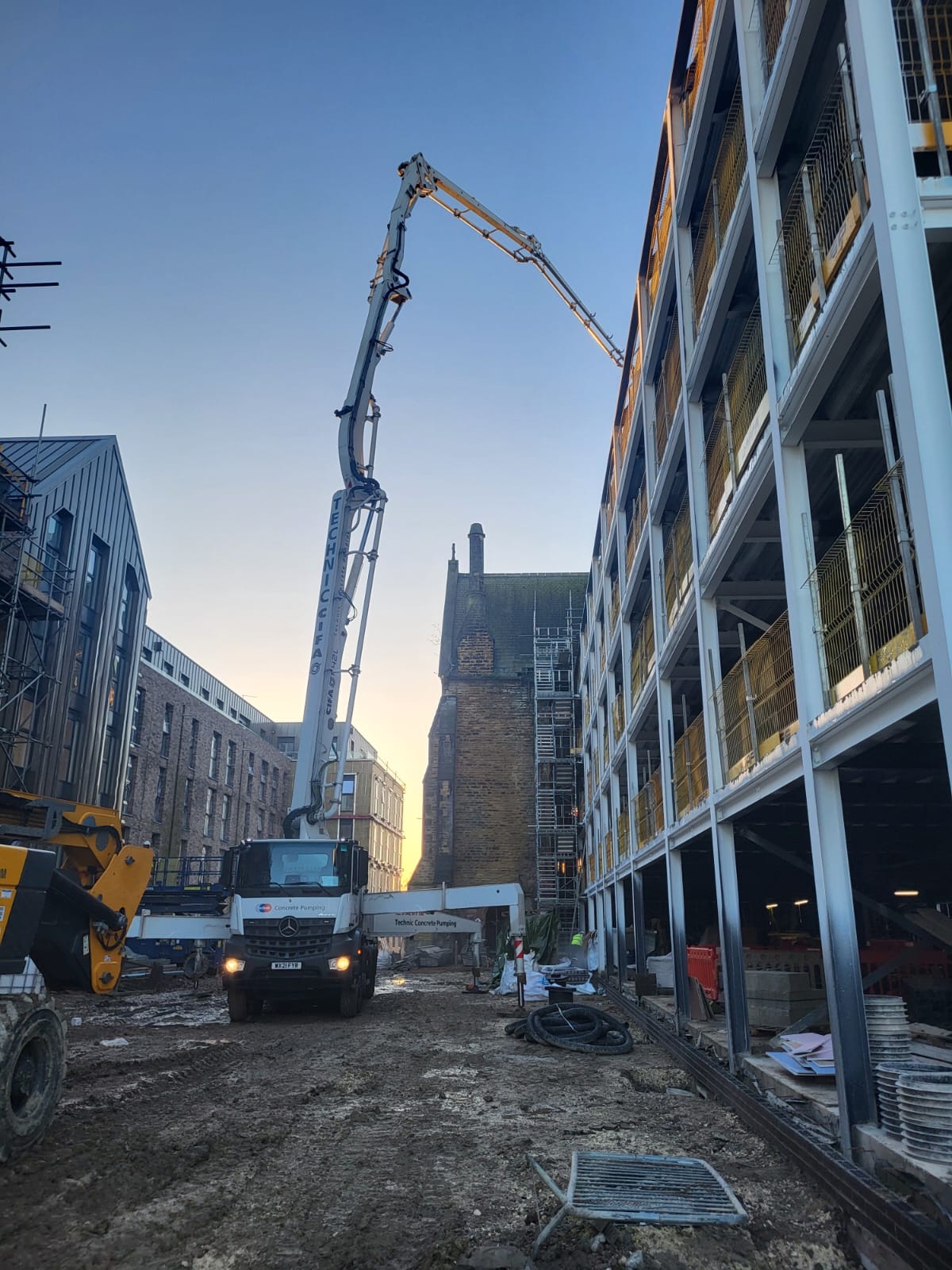
Access decides the approach on most home projects. Terraced and semi-detached houses often have a side passage less than a metre wide, steps down to the garden or a shared entrance that must stay clear for neighbours. A line pump mounted on a compact lorry sits on the road and pushes concrete through flexible hoses for distances of up to 150 metres, following bends, passing through gateways and coping with gentle changes in level.
Where the route is blocked altogether, a boom pump can lift the concrete over the roofline and place it in the garden from above. For the majority of domestic jobs, however, the line pump is the answer. Its smaller vehicle avoids the parking and weight concerns that a larger unit would raise on a residential street, and set up takes a matter of minutes.
Why pumping beats barrowing by hand
A modest four cubic metre pour is more than fifty barrow loads, each weighing well over a hundred kilograms, moved along a narrow path and tipped into a trench. It is slow, tiring and hard on the property. Pumping changes the arithmetic in five ways.
| On the day | Barrowing by hand | With a concrete pump |
|---|---|---|
| Workability | The pour stretches out and the mix stiffens before the last load is in | The pour is finished while the concrete is still fully workable |
| Labour | A full team is needed just to keep the barrows moving | Two people can manage a pour that would otherwise need a team |
| Finished slab | Joins form between batches as the pour slows down | Concrete is placed continuously, so there are fewer joins and a stronger slab |
| Your property | Lawns, paving and doorways take a beating all day | Nothing heavy is wheeled across the garden or through the house |
| Safety | Repeated heavy lifting along a narrow, wet route | The lifting and the strain injuries are removed from the day entirely |
Our domestic concrete pumping service is built around exactly these projects, with pumps and operators chosen to suit residential sites.
A pump is usually worth it when
- The pour is more than a few barrow loads.
- The mixer truck has to stay out on the road.
- The pour point is at the side or the rear of the property.
- The route runs through a narrow passage, a gate or across a finished lawn.
- The concrete has to be placed at a level the truck cannot discharge to.
You may not need one when
If the mixer can back up to the pour and discharge straight into it, and the volume is small enough for a barrow load or two, hand placing may be all the job needs.
Tell us what you are pouring and we will say so if that is the case. We would rather give you honest advice than book a pump you do not need.
What to expect on the day
Once you have confirmed your pour date and ordered the concrete, we will ask for a few details so we can match the right pump to the job.
Send us these five things
- The volume of concrete in cubic metres. Our volume calculator gives a quick estimate.
- A description of the access from the road to the pour point.
- A few photographs of that route, including any gates, steps or narrow sections.
- The date of the pour and the delivery times you have booked.
- Who is supplying the concrete, so we can speak to them directly if it helps.
From this we recommend the pump and agree a time for arrival. We are happy to speak to your concrete supplier so that the pump is set up and primed before the first mixer arrives.
On the day, the pump parks on firm ground, the operator lays and secures the hoses, and the line is primed before the concrete is discharged into the hopper. Your team directs the hose while the operator controls the flow.
When the pour is complete, the hoses are cleared and the pump is cleaned in an agreed area, never into drains or watercourses.

A typical extension or driveway pour is finished within a couple of hours of the pump arriving, leaving your team free to level and finish the concrete.
Book the pump and the concrete for the same window
Standing time is the one cost that catches home projects out. If the pump is set up and the first mixer is an hour late, the clock runs on a machine that is not moving concrete. Confirm both bookings for the same window and have the site ready before the truck arrives. Our guide to concrete pump hire cost explains how a quote is put together.
Got a Home Project Coming Up?
Tell us about your extension, driveway or garden build and we will find the right pump for the job, coordinate with your concrete supplier and give you a fixed quote with no surprises. Call 01942 679100 or contact us online.